recording project
studio track sheet
a studio tack sheet is a chart which tells us what instruments are on each individual track .
 source: (https://www.google.com/search?q=studio+track+sheet&source=lnms&sa=X&ved=0ahUKEwjI3tGrtbPgAhXM6OAKHa-NANsQ_AUICSgA&biw=1920&bih=1006&dpr=1)
for example on the track sheet above the kick drum is plugged into track 1/25 in studio 3
- sound checking
- when sound checking its important to ensure that the musician plays exactly how he is going to play during the recording or live show so that gain can be set appropriately.
- different engineers obviously have there different order or process in which they sound check but for example sake if we are starting with the drum kit we do this.
- when sound checking the drum the gain is very important in order to properly achieve this you can tell the musician to play single but strong strokes on each part of the drum or playing the grove strong.
- personally i check the drum kit in this order:
Kick,Snare,Toms (smallest to largest),Cymbal mics /overheads (from stage right to stage left)
close micing /spot micing:
this method of micing up things such as the snare and toms Spot miking (also called close miking)it involves putting your microphone within a couple of feet of the sound source. an advantage of close micing is it that you can edit specific instruments to best fit your final product.
When checking each instrument/mic you should be adjusting the following, in order of importance:
- Gain — Use channel meters to find the “sweet spot”, usually where green turns to yellow/orange on the meters
- Fader — Typically around unity. Just keep it below the master fader, and make sure it sounds good in the room
- Gate — Only necessary on kick, snare, toms, and maybe a particularly noisy guitar amp
- EQ — Mostly subtractive EQ to correct problems
- Compression — Mostly for vocals to keep them out front in the mix
- FX sends — Hall reverbs for drums, and plate reverbs and tap delays for vocals are common
what is a DI box?
A DI unit is an electronic device typically used in recording studios and in sound reinforcement systems to connect a high-output impedance, line level, unbalanced output signal to a low-impedance, microphone level, balanced input, usually via an XLR connector and XLR cable.
What does a passive DI box do?
It takes unbalanced inputs, and coverts them to a balanced output. In addition to this, many DI boxes offer the ability to take an instrument level input (such as a guitar or bass) and match the impedance to an XLR mic input, so that it can be easily plugged into a mixing desk.
 source: (https://www.gear4music.com/PA-DJ-and-Lighting/BSS-AR-133-Active-DI-Box/UZ0)
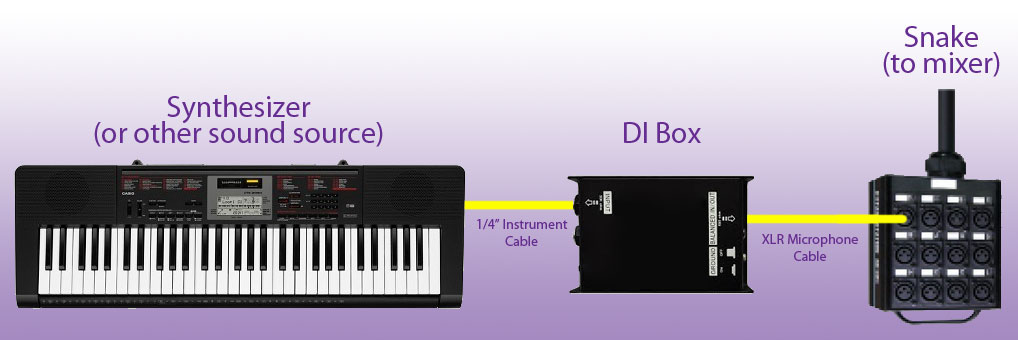
Active DI Boxes have active circuitry, which means that they require power. This is usually supplied via phantom power or an internal battery. Whereas passive DIs use transformers to change signal impedance, the active DI uses powered amps.
what is phantom power?
within the studio there are only a few instrument/pieces of equipment that require this power .for example piano and condenser mics both need phantom power in order to record.condenser mics also require phantom power.


talk back mic
what is a stage box?connects each individual input from each instrument/mic to the mixer via one cable. the advantage of this is it looks much neater causes less hazards consequently allowing inputs to travel a further distance. source: (https://www.astounded.com/shop/adam-hall-24-xlr-input-4-return-stagebox-with-30m-multicore/)

within this picture it shows the function of the stage box within more detail.the stageboxs connects inputs via microphones through multicore cable which carries signals to the front of house mixer.the mixer then send an output from front of house to things such as monitors and front of house speakers
Overdubbing is a technique used in audio recording, whereby a musical passage is recorded two or more times. This practice can be found with singers, as well as with instruments, or ensembles/orchestras.
pros:
if a single musician in a band makes a mistake it will not ruin the whole recording, because their part can be replaced.
The inability of the singer to perform well might mean that the band would have to play the song over and over again till the vocalist got their performance right but no they can play and record it once still allowing the singer the opportunity for multiple takes.
allows the each individual part to be focussed on and perfected to the artist and producer's taste.
cons:
you can wear out a performer by having them record to many times you no longer get 100% from them recording is then not to its best quality
Easy to accept average performances thinking they can be fixed with editing.
talk back mic
A microphone that provides a means of communication between the engineer and producer in the studio control room to the musicians performing in the studio. A talkback mic may be mounted into a mixing console or monitor controller and routed into the studio’s headphone/cue system, or may be a freestanding mic that is connected to the studio’s headphone/cue system.

Comments
Post a Comment